LAST DAYS

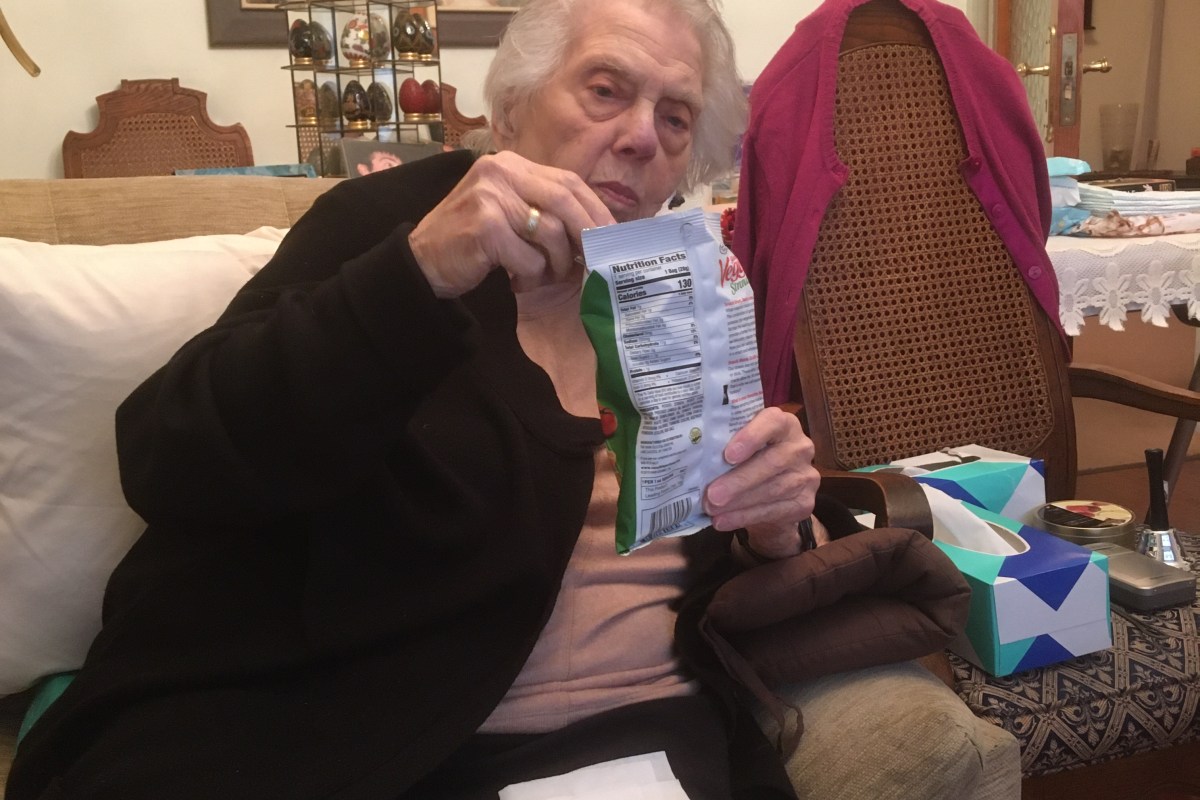
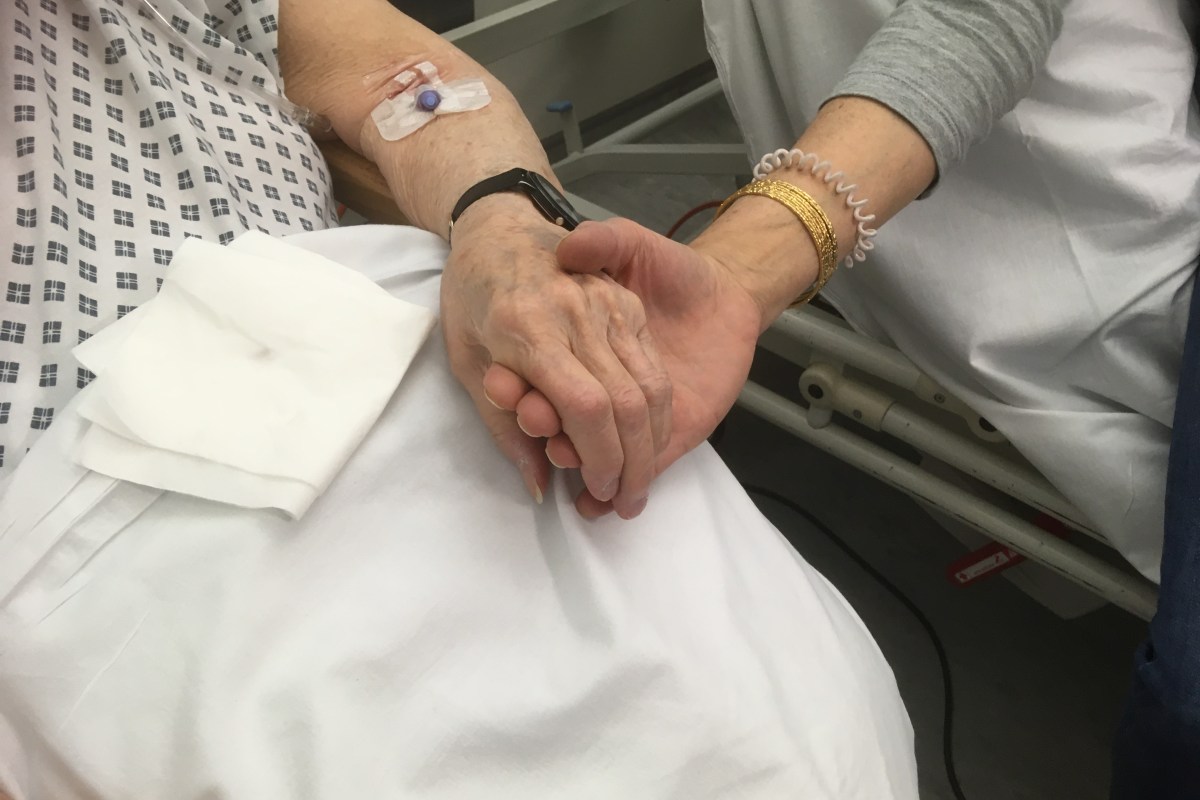
I’m in the same room where my dad died, when he was in the final stages of his life. Except, I’m lying on the bed and my mother, Esther sits opposite me in an armchair. The bed is a hospital bed, provided by the NHS, along with other necessities for someone who is in the final stages of her life. I am here every day, witnessing, helping, caring for my mum along with her full-time carer. And it is hard.

The past three weeks have seen mum in A&E twice. The most dramatic episode that took place the first time was when I told off a man with a bloody nose whose verbal abuse to the staff was shocking. I asked mum if she was angry at my outburst. ‘No,’ she said, ‘I’m proud of you.’

Two weeks later and we were back, this time because mum was having trouble breathing. She was moved from a small room to what I called a family room. The immediate family was there. Me, Stella, my niece and nephews, and for a brief time, my mum’s carer, Merly. Eventually I sent them home, apart from Stella.

We stayed awake through the night. I thought mum was going to die, but she held on, is holding on, despite desperately wanting to go. She’s had enough. Never mind being in the final stages of her life, she’d fed up with politics and politicians and the state of the world. She despairs every time we listen to the news together.

Stella and I managed ten minutes of sleep that night, if that. Stella stretched out on a blanket on the floor, with a puffa coat covering her while I sat in an uncomfortable chair, bouts of taking mum to the loo my only exercise. Conversations with weekend doctors in the dark, asking if I had an LPA (Lasting Power of Attorney) which sent me off into floods of tears. Since waking up on Sat morning and arriving home on Sunday night, Stella and I had been awake for 38 hours. Not since my 40th birthday have we lasted that long on small amounts of food and little water.

A 6.30am, I walked to a local café, the only one open that early. The food was average, but the coffee was hot and proper, and we were grateful for that small gift.

Mum was moved to the adult assessment unit, in a room (not strictly a ward) with three other elderly women. Some went home and new women arrived with wishes and wants of their own. The elderly and sick need to be given autonomy, I am very clear about this, I am with my mum. I was with my dad and sister. They have no control over their bodies so we must offer them choice, ask what they want, and not give them what we think they should have. Dignity, respect, choice. These are vital human rights. Personal cleanliness is also important. Just because they are old and sick doesn’t mean they don’t want to be clean. They do.

I came to know most of the staff, the OTs, the just-qualified nurses, the staff nurses, the drivers and cleaners and tea and coffee and lunch-bringers. The other women provided little jewels during a very bleak time. Witnessing my 91-year-old mother struggle to walk, lose her appetite, tell me several times a day how much she wanted to die, asked us to shoot her or give her a pill, are moments I wouldn’t wish on anyone. Accompanying my mum on her four-day stay were My Mum – called this by her daughter so we never found out her name. Every time Stella and I head ‘my mum,’ our hearts melted. Then Victoria took over when My Mum went home. Bridget took over from Victoria. Bridget with her swollen legs and green cardigan. Adjacent to mum was Mrs Patel. She was amused to find out that mum and I were born in Calcutta – Kolkata now, she said. And then mum and Mrs Patel counted to ten together in Hindi. See, sparkling gems among the unpolished stones. Mrs Patel has no family. She lives alone. Sometimes someone will bring her food, sometimes she manages to clean her home. Mostly she is alone, with little to eat, no one to clean her or her home and I should imagine, she is filled with loneliness. ‘It’s really hard,’ she said.

It is really hard.

Nora Lilian, Lilian to her friends, stayed one night and went home. Her father died at the age of 48 from an asthma attack. She loves Coronation Street and EastEnders. She lives alone. She has no children. Fragile Maud replaced her, crumpled like the NHS sheets she lay in, a tiny figure in her bed. Her head lifted, she mumbled something and turned. And I noticed the bars on her bed had not been raised, so I rushed over to stop her falling out. When Maud left, another woman came, I never knew her name, but she was very chatty. Not as chatty as the woman who took over from Mrs Patel. Kathy was part Romany; she spoke fluent Italian thanks to her ex-husband. She talked and talked, and I thought all these women live alone, they have no one to talk to, so they are talking to me. She told me about leaving her husband in Turin, leaving with her son. She had made provisions, sent a shipment off to the UK without her husband knowing and was at the airport when a woman came up to her, looked at her sad face and said, ‘What is your story, my daughter?’ The woman was Maya Angelou. Kathy knew who she was because she had read all her books. She also met Rod Stewart before he was famous, but that’s another story.

And all the time I am with mum every day from morning to night, crossing London, from south to north as I have been doing for so many years. Christmas light up, passing the skaters and lovers and tourists and shoppers. Passing so many people with their own stories of happiness and despair.

There was the moment when one woman couldn’t find her shoes which meant all the women decided they wanted to find their shoes. Maud lifted her small head, ‘Are my shoes there?’ I walked over. ‘Yes Maud, they are.’ ‘Where are they?’ she said. ‘They’re here, down by your bed.’ She dropped her gaze, smiled. ‘Oh yes,’ and flopped back. Her shoes were there. Beautiful red shoes. Her daughter told me that they are her only remaining pair of shoes and she adores them. (And yes, I am already writing a story about it, so hands off!). After that I had to convince all the women that all their shoes were safe and that they wouldn’t be returning home in red or beige hospital socks or bare feet!

During the past week I’ve learned so much about myself, my strengths and weaknesses, my sharing and teamwork with Stella, asking for help, ensuring Merly has rest too, because she is providing the main care, I’m here to assist. I’ve watched myself do all the things I really didn’t want to do but ended up doing because I had no choice and actually, it’s okay. I learned about the lonely women, the women without children, daughters caring for mothers, the NHS who is pushed to the limit, those who have no voice or no one to voice their concerns, the sad and lonely people, so many so alone, so many hopeless situations with no end in sight. I think about my old age and it terrifies me.

On our way home from hospital late on Thursday night with two other patients in the back of the ambulance, I was given an envelope to give to the driver. He didn’t want it, so I kept it. The sat nav was confusing him and he couldn’t work out how to get the first patient home. My phone and Google maps came to the rescue. Mum asked which street we were on. She said, ‘I lived around the corner when I arrived in London,’ and proceeded to reel off every street name in the vicinity. While she couldn’t see where we were, she had a good idea of how it all looked.  Her mind recalled the landscape perfectly. Her memory is all there and I am grateful. Her eyesight has all but gone, she is deaf without her hearing aids, she relies on a walker now and has mastered it so well I call her Lewis Hamilton. At 91 she is still learning. She is adapting to her new normal. Due to small vessel disease in her brain her speech is laboured and makes her sound as if she has had a stroke. She hasn’t. We know because she had a brain scan.

Home again, with mum settled, I remembered the envelope. I opened it. Instructions for the driver. DNR. These are mum’s wishes. She has told me several times. Do not attempt CPR. A few words describing my mum’s condition. And two words crossed out. Stella deciphered them. Cognitive decline. She does not have cognitive decline. Her words are stilted, her senses gone, her mind is as sharp as it has ever been.

Mum has advanced heart failure. A chest infection and fluid on her lungs have been treated. The latter has now almost cleared, but her heart will give out at some time. It’s been a hellish week, with little sleep, me waking at 3am, my mind whirling, wanting to be with mum but also wanting to be at home with my wife, do normal things, like eat dinner and watch TV, run and exercise and see friends. But mum time is precious. I can exercise later, when there is no need for my care or calming words.

Mum is tired, so very tired. She is ready to leave this life for wherever she is going. She has lived a full life. She has travelled all over the world and seen sights I will probably never see. She was in India during partition, she came to post-war London aged 22, leaving behind her old life and made her way on her own. She worked with my dad until their early 80s. She was on the Mall for the Queen’s coronation. She’s seen Margot Fonteyn dance and Liberace play; Danny Kaye and Shirley Bassey and I took her to see Liza Minnelli. I’ll never forget it because mum stood and applauded. She’s ready to go when the time comes. And I’m as ready as I can be. I have cried every day. I have cried in the middle of the night, in hospital, in the shower, with my mum and my nieces and nephews, with mum’s next-door neighbour, in the car, in the kitchen, on the road. I have drained myself of tears but there are always more. It’s been hard, it is hard. Harder in a way than watching my sister die and my father’s horrific pain before he died. Mum could go on for a day or a week or a month. For now, I want to ensure her last days are comfortable with quiet times and meaningful conversations. It’s the best I can offer.


IT’S OKAY TO HAVE AN OPINION. IT’S NEVER OKAY TO BULLY.

Last Saturday 22nd June, my wife, along with two other guest reviewers and a presenter, was on BBC Radio 4’s Saturday Review show. In the mix of events to discuss was Toy Story 4. I listened to the programme on Saturday evening and again several times later. Everyone is entitled to their opinion whether they love or loathe something.  Disagreeing with one another is part of life. It is a human right to have an opinion. But when you attack that human right so fiercely, what emerges is the most vitriolic bullying on social media and that is never acceptable. And when those who do the bullying get their evidence totally wrong, and a whisper of inaccurate facts escalate into a mountain of undiluted, dangerous hate, social media has a lot to answer for. This week has shown me the most detrimental use of social media.

Stella’s comments about the film were simple; better representation for everyone, more diversity, whether toys or human. That is the essence of what she, and other reviewers said. However, Stella has been singled out and has been gravely misquoted on just about every media platform, with death threats on Twitter and toxic insults directed at her at every opportunity.

Good Morning Britain decided it would make good material. Devon Live wrongly reported that Stella had spoken to the presenters of that programme when she hadn’t. She had nothing to do with the programme, it was Dr Shola Mos-Shogbamimu who was on the programme. Devon Live still hasn’t corrected their on line copy, crediting Stella, not Dr Mos-Shogbamimu with the latter’s words. And today Toby Young has tweeted in the most offensive way, which is what I expect of him. All these horrid comments confirm for me that Stella is right to stand up for and defend equal representation. The likes of Toby Young never cared about inclusion or diversity, it is not part of their remit.

Stella has also been called a film critic, which she is not. She very occasionally reviews films, she is no Mark Kermode. She has been outrageously misquoted as saying Disney is racist, which she definitely did not say. When challenged, the bullies on Twitter said they hadn’t heard the programme. So where did their misinformation come from? One of our tabloids, that’s where. From there it went to a broadsheet and on it goes, the inaccuracies snowballing and giving way to yet more hatred, the kind I hope I never have to witness again. Words do hurt and create damage.

The events of this past week have left a bitter taste in my mouth. Human behaviour has once again let me down, proving to me that they, the bullies, the haters, the angry crowd who has been given carte blanche to say what they want, how they want and whenever they want, try to silence those of us who do speak out, those of us who do not honey coat everything we see or hear, who try to be inclusive and defend diversity.

Apart from the intense bullying, which has pretty much kept going for almost a week, I ask myself if we cannot stand up for each other what chance do we have of living in any sort of peace with any sort of tolerance, accepting our differences while trying to make a difference? The truth is, we don’t.


RUNNING FOR MS-UK

IMG_3734.JPG

For years I’ve told everyone never to run because it’s bad for you. I’ve encountered many runners with strapped knees and brightly coloured tape, ankle supports and sore hips all bemoaning the fact that running did this to them as if they were not in charge of their bodies. But I had no interest in running so never paid much attention.

Exactly three years ago today on March 30th, 2016 I went for a run around my local park. Bored with the gym and not wanting to be inside on a glorious spring day, my wife suggested I go for a run. Yeah, why not. I had trainers, a quick couple of laps and I’d be home. I was 56. I ran about 2 metres and stopped. I couldn’t do it. I was out of breath, my legs wouldn’t work, it was absolute torture. I couldn’t understand it. I was fit, I thought I was fit. Didn’t gym and yoga and Pilates and swimming all make me super fit?  Er…no. Toned, well-stretched, with good balance, but as far as my cardio went, I was totally rubbish. I couldn’t even blame my dire attempt on my mild asthma. I stomped home filled with despair.

I don’t like not being able to do something, it’s not in my character. Facebook came to the rescue with loads of recommendations to do the NHS couch to 5k. The walk-run method has worked for thousands and it worked for me. In 9 weeks I could run 5k without stopping. I remember my first 5k race, I was overjoyed yet I couldn’t imagine running any further distance, a 10k was unimaginable. But 5k wasn’t enough. I wanted more.  And so it progressed. My first 10k was on Clapham Common, I was ecstatic. That year I also slipped in two triathlons. I’m still not sure how I managed to finish them. A 10-miler around Richmond Park followed, and then a half in 2018 and I loved it. The spirit of the crowd, the other runners, the super speedy and the slower among us, running for ourselves and often for charity.  A 31k ultra-marathon came next in July 2018 but I wasn’t prepared and I walked a lot of it, trail running was new to me. But this was a test to see how body and mind responded. I couldn’t walk down stairs for 4 days but my mind was okay. Then I ran a dreadful 15 miler because yet again, I wasn’t prepared, I didn’t do the work and my legs knew it. Two friends helped me cross the finish line. I knew I had to be prepared next time. Looking back, I really enjoyed running and walking in the Chilterns, often alone as others were ahead and behind, time to think about everything, getting lost and then getting found. Prior to that I didn’t even know what an ultra-marathon was. It’s anything over 26.2 miles!

Some people said, what about a marathon? To which I laughed in their faces. Don’t be ridiculous, I’m never running a marathon, I have never wanted to, I have no interest in it and most important of all, I do not want to get injured.

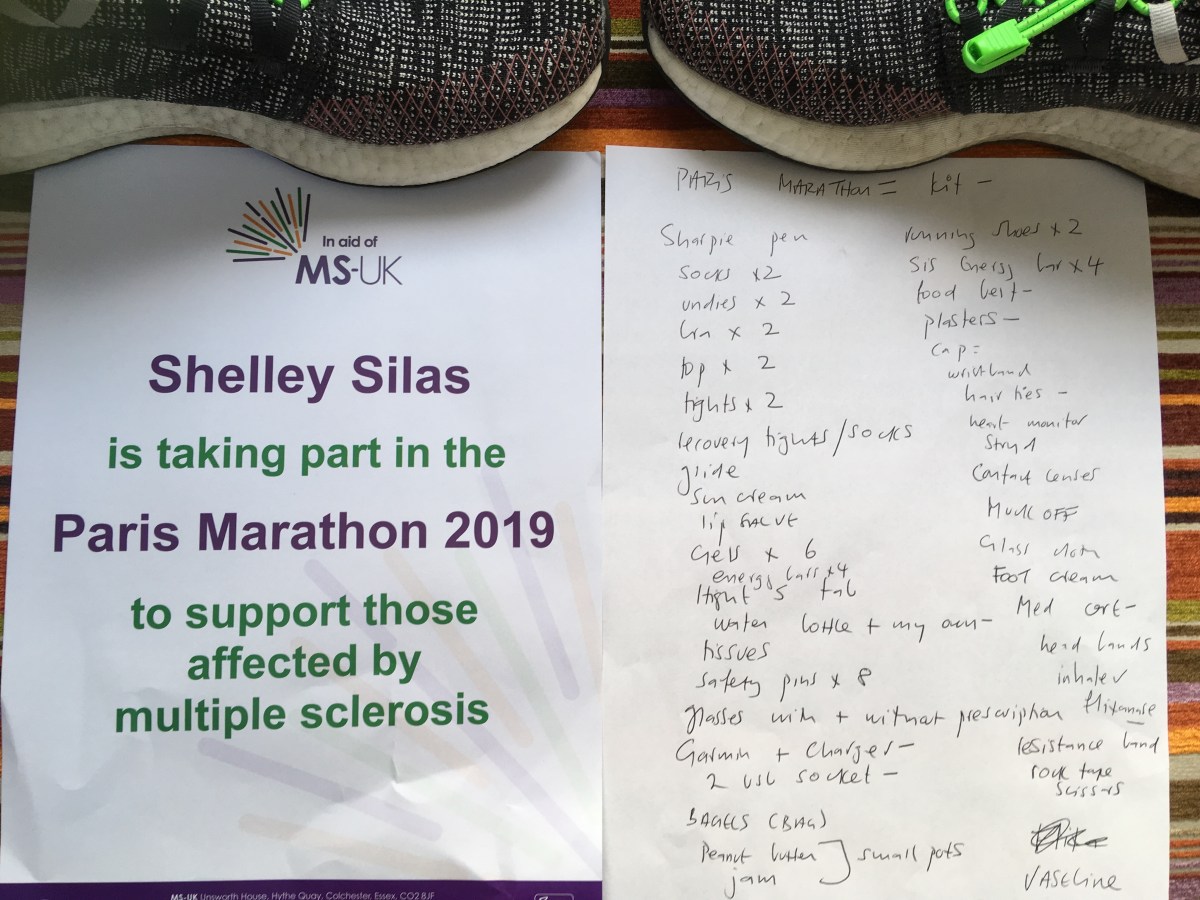
In 2 weeks, on Sunday April 14th, I am running the Paris marathon (because I didn’t get into London, not because I am fancy!).  As I said, this is something I never dreamed of, it wasn’t on a bucket list, I didn’t watch Mo and Paula and Eliud and Mary and think, I want to do that, I want to be them. I still don’t want to be them, which is just as well because it’s never going to happen. Now I watch them in awe, the speed, the focus, the determination, the keeping on going. They are remarkable. Keeping on going is hard. But I have kept on going. I’ve been training since November 21st, 4 runs a week, comprising of a longer run each week and three shorter. I’ve completed all but one run due to being unwell. And I’ve had help.

A runner (he’s run more than 60 marathons and ultras and super-ultra 100-milers) called Michael has been with me all the way. He sorted my training schedule and has run 3 of the longer runs with me at my pace and has always mapped the route. He texts me weekly to find out how my legs are and how I am. I couldn’t do this without his guidance and belief – because right now, I am absolutely terrified that I won’t be able to complete it or feel faint or get heat stroke or fall into the Seine or trip over the many cobblestones or hurt so badly I’ll have to be stretchered out or spend all my time in the portaloos. Yes, I am scared because it has been hard, getting lost, running up hills without Kate Bush’s help and scrambling down them, fitting in training with work and life and my magnificent, supportive wife (I did remind her that this is all her fault), and my 90 year old mum and the cold and hot and fuelling properly and falling over and bouncing back and hurting and the good runs, so many good runs when it all comes together – but mostly, it’s been hard. But the satisfaction of having run outweighs everything else.

I’m running as a 60th birthday present to myself but also to raise funds for a charity, as I have been doing since I started running. This year that charity is MS-UK.

MS-UK does the most vital work, with people having to cope with MS on a day-to-day basis. Unlike other MS charities, MS-UK does not receive government funding or money from pharmaceutical companies, it is there to provide direct care for people having to adapt their lives to MS. My friend Jim, who is in the later stages of MS, suggested MS-UK. It’s smaller than the well known charities, but small is as vital and significant and needs our help too.

I’ve reached my target but more donations are always welcome. I have been overwhelmed by the generosity and kindness of family and friends and total strangers, especially when times are hard and the world is in chaos. I will run my best, not my fastest, I will take care while taking in the sights and smells of Paris, and I will carry every good wish lightly on my back. And I will acknowledge my immense privilege and good fortune. And I will wear my t-shirt and medal when you next see me.

For more information about MS-UK –

https://www.ms-uk.org

If you’d like to donate to my Just Giving Page – here it is

https://www.justgiving.com/fundraising/shelley-silas5


In Response To Giles Fraser

Having read Giles Fraser’s article ‘Why won’t Remainers talk about family?’ I am filled with anger at his presumptions that remainers, like me, won’t talk about family. We do talk about family all the time and quite frankly I find his words dismissive, arrogant and ill-informed.

I do agree that the woman who called her surgery to ask about help with her father’s ‘accident’ could have sorted it out herself immediately (not least because it must have been hugely distressing for him), perhaps now she has considered alternative help for her father.

I spent time being around my sister when she was sick and then dying of bowel cancer, but until her final week she could pretty much cope. I took her to chemo and hospital appointments while working freelance, I gave up a lot of my time and I did so out of my own choice and willingly.

My father’s illness came fast and those speedy months were the most horrendous time of our lives, especially for my mum. During his final two weeks NHS carers came 4 times a day, they were sensational, yes all from other countries and they were kind and generous and he adored them all. They were the ‘new’ in his otherwise ‘old’ life. They provided a different attention to the one we gave him. The women who sat with dad at night so that we could sleep were possibly the most exceptional women I have ever met, respectful, courteous, humane.

But Giles Fraser is not talking about end of life care (though he does rather crudely mention Dignitas, ‘And care homes for the elderly become ways to warehouse those who cannot be persuaded to make the trip to Dignitas’. He never mentions the cost of Dignitas, unaffordable by most and a choice many don’t want or need). He is talking about the day to day care of the elderly. He is talking about my mother and countless other mothers and fathers.

When my dad died I took on my mum’s care, financial and emotional, actually I took on everything, because there is just me, with others helping occasionally. I look after her household. I pay the bills, I take her to Moorfields for her eyes and the Royal Free for her heart and hearing and to her GP whenever she needs a blood test or injection in her arthritic knee or flu jab or anything else. I do most of her shopping and call her about 6 times a day for a chat, a catch up on the news or just to say hello and I am with her for many hours 2-3 times a week, every week. But after mum had a couple of falls we spoke about full-time care. She already had a carer staying overnight, and yes it was hard for mum to have a stranger in her house, but after some time she became accustomed to it. She provides the care that I cannot provide, the very personal care that I do not want to provide. Why? Because it is vital I live my life otherwise I might end up resenting my mother and I never want to be that person. And mum wants me to live my life, because she has lived hers, although I can’t go away for more than a week and never far away. She says when I am gone you can go wherever you like.

Prior to my mum’s landscape changing from married life to widowhood, I always wondered why other people didn’t move in with their elderly parent(s) or have their parent(s) move in with them. I was quite critical of people until I found myself in their position and then I realised why. I don’t want to wash my mother or shower my mother and she doesn’t want me to, it is humiliating for her.  I do not want to be my mum’s carer – I want to be her daughter, I want to have a mother/daughter relationship which is full of annoyance and laugher and memories and anecdotes not resentment and anger, me wanting to be elsewhere and worse still, remorse. I give my mother what her carer cannot give her and she gives my mum everything I cannot and do not want to give my mum. It works for us all.

We are fortunate that mum can afford to pay for care, she has a fabulous carer from the Philippines who chooses to work here, no one has made her live here. Yes, she has brothers and sisters in the Philippines, but she is the one sending money home. If she remained there her life and finances would be very different. Her tax, NI and pension and holiday pay are paid by mum as her employer. She has heaps of time off whenever I am with mum and when mum’s friends or family visit.

As to the woman whose family all live abroad, I wonder if they moved away before she became a widow or elderly? Perhaps her family asked her to go and live with them – we don’t know, so Giles Fraser cannot simply blame it on her children. We all, mostly, have choices.

What would I do if mum couldn’t have afforded private care? My wife and I discussed it long ago, we would either move in with mum (much as the thought of returning to my childhood postcode fills me with dread) or have mum move here, but she wouldn’t know anyone and would be out of her comfort zone – we live an hour’s drive away in SE London while she is in NW London – and because of her poor sight it is best she stays in her own home as she knows her way around her house and is safe there. I would never move her into a care home, to do so would encourage her to give up totally, live by someone else’s rules and it is vital for our elderly, if they are able, to do as much for themselves as possible.

Giles Fraser says ‘Ideally, then, people should live close to their parents’. Why? We live where we can afford to live and choose to live. We live on the south side of the river because my parents refused to accept my same sex relationship and I didn’t feel comfortable living near my parents. My mother often berates my long dead father for this and blames him. We all have different reasons for living away from our parents, it’s pompous of Giles Fraser to decide where we should live and why.

And the bit that really makes me angry is when Giles Fraser talks of children looking after their parents because he omits to consider those of us who, for whatever reason, do not have children. And by the way, there’s no guarantee that children would ever look after their parents, whether as full time carers or in my capacity. I hope I will live a long healthy life, able to look after myself without asking others for help. I have nieces and nephews, lots of them and am surrounded by wonderful younger friends, but I wouldn’t expect them to give up their lives in order to care for me, although I am sure they would. My wife and I already think ahead, about all the what ifs. There will be decisions to make, changes to be made.

If only Giles Fraser looked around and witnessed the extended family, the communities within communities who do look after and care for and help he might see a very different picture emerging of his otherwise ill-informed account. I only hope when he reaches a certain age that his children are living next door, on either side of him if not in his house and offer him every kind of support and personal care he requires, giving up their jobs and lives 24/7 in order to be his carers without an ounce of resentment.


A WORK AND LIFE IN PROGRESS

AB + Productions, POSITIVE – WORKING TITLE – SUNDAY 26th NOVEMBER 2017
Camden People’s Theatre, London

Devised, Made, Curated, by Shelley Silas & Martyn Duffy
Performed by Martyn Duffy
Sound by Martyn Duffy
Additional material by friends.


Almost 5 years ago, I took my friend Martyn out for a pizza. He was having a low time, work, life, health matters were not being kind to him. We were planning our first Fun Palace at Brockwell Lido and post meeting Martyn and I decided to break bread and drink wine and talk. We chatted about his life, his many illnesses. I said we should create a show about what it’s like to be alive when you were supposed to be dead, when you had planned your funeral several times, said goodbye many more – how did that feel? We talked a little more, made some notes, went away to think, our lives got in the way and that was about it.

Fast forward a couple of years. We were at the beach with his husband and my wife and two close friends. They all went for a walk in the evening, while Martyn and I decided to stay in our warm, comfortable cottage. Martyn was low again. I asked him how he was, where he was at this point in his life, other illnesses were looming. Surgery was not far away. We talked at length and the show we had discussed a couple of years earlier and we decided to take it forwards, to make it happen. Neither of us knew how.

We spent weeks on a cruelly long and detailed application for funding, hours and hours and friends read it and advised us and we were turned down.

We were fed up with the whole process, despite our let down, we continued with our ‘idea’, and via my wife via a friend who worked at Camden People’s Theatre, we were invited to create a showing for their current The Shape of Things to Come: Big Bang season. We started from not having a clue what we were doing or how to do it. We knew that sound was important to both of us and Martyn is great at anything sound related, he has taught himself to use equipment that I can barely pronounce. We knew it was about pain and memory and the stigma attached to illness, but more than that, we wanted to incorporate friends’ memories, not just Martyn’s memories of his own illnesses.

We had several meetings over lunches (Martyn is a superb cook) and really had no idea what we were trying to say or achieve. Over the months, a process that I am not used to, started to drip feed idea and thoughts into our minds. We talked a great deal about so much, Martyn opened up in a way I can only describe as gracious and generous. We had a beginning, then another beginning and so it went with days of nothing coming up and ideas we binned and time passing and twenty minutes to fill. It was hard. It is hard. Devising is much harder than sitting alone with a concrete idea and writing a script by yourself. But having someone to bounce ideas off is so much better and more fun and it is hard. Devising is a different process, with a definite end goal if you are fortunate to have a theatre ready to say yes, whether it’s a showing or a full length piece. You have to trust that the process will happen, it will show itself and somehow it will come together, and when it does you know it’s been worth the waiting and wondering and banging your head against a brick wall, and hoping one of you will come up with something astonishing.

We have come up with 20 mins, not astonishing, but a good start, with everything we wanted to include for a showing, and a little more, after his husband and my wife had their own private showing a few days ago and gave us a couple of welcome suggestions. There are no egos involved, it’s not about Martyn’s contribution or mine it’s about making the piece, the twenty minutes that took so long to formulate, the very best it can be for an audience who will go away and hopefully, give us feedback so we can create towards a longer show next year. Who knows, I might be in that version, but that longer piece has already started to grow and will have three sections; Resilience, Revelation, Recall. The latter forms the showing at Camden People’s Theatre on Sunday 26th November.

Shelley Silas

November 21st, 2017

Two Weeks to Give it a Go

It all started with a chat in a pub with two Ironwomen friends, and then a conversation in the gym about the Crystal Palace Triathlon. All it needed for me to apply was the use of the word fun.

Two weeks today, Crystal Palace Triathlon 2017 will be over. I am familiar with the course, I did a novice training day and, because it’s what I do, I have planned and researched and tried to overcome my fears and nerves and trained so hard and everything was going so well. The one thing I didn’t plan on happening was to get a cold and chest infection, possibly brought on by training too hard (mum to me yesterday for about the 100th time, ‘You must remember you’re not 25.” Thanks mum), at an indoor pool. Crystal Palace pool and the Lido have never given me anything other than tepid or freezing cold water.

I have been home for two days, nursed by Stella, who was looking forward to a romantic weekend before she flies off to New Zealand for a non-stop work tour. We had to cancel dinner with close friends, which I am still upset about and tomorrow will be my fifth day of no exercise, which, those of you who have been injured/unable to exercise will know brings difficulty, frustration and upset. I have Googled everything, from what to eat the night before and how to change a puncture, as this is the one thing I haven’t a clue how to do, and on triathlons you are not allowed to ask for help. I have read the British Triathlon Competition Rules, and there are HEAPS of them. I have learned new terminology, such as drafting (illegal unless it is a draft-legal triathlon) and being lapped and immediately disqualified. No holding on to trees or anything else to help you balance, no floatation aids allowed in the pool, and NO GOING TOPLESS.

Screen Shot 2017-04-30 at 23.45.57

I like the simple course map drawings, but don’t let the simplicity fool you. It’s not flat and it’s not easy. I will probably be one of the first in the pool, being one of the slowest, and if I can recognise my bike while still wearing my prescription goggles as I walk to transition, all good. You are not allowed to put anything like a balloon or mascot or your wife or a close friend, beside your bike to help identification. Without glasses, that will be hard. With prescription goggles I will look like an idiot, but I don’t care. I will wear my tri suit with pride, try not to fall off my bike and damage a tree and run, run, run until I reach that track and keep going until the finish line.

Did someone say something about fun?

Tri Tri Tri again.

As my first sprint tri approaches (yes, I’m doing two), I signed up for a novice training session at Crystal Palace, where the event will take place on May 14th. A couple of Sundays ago, I headed off on my bike for the 4-hour novice tri training session. I was by far the oldest, even the instructor was younger than me, although he was sure he was older.   Several of the group had run marathons or were super speedy swimmers and accomplished cyclists. I am pretty average at all three sports. Pretty average is an okay place to be. Or so I thought.

I set off with my usual gusto, cycling along mostly flat roads, until I reached a hill that I have cycled before. Twice. Apparently lots of really good, really competitive cyclists ride up and down this hill at night to train. Once a month is enough for me. When I reached the top, Crystal Palace would be opposite, on the other side of a main road. However, as I approached the top of the hill I decided to stop and take a moment. It’s often the moments that count. I unclipped my left cleat, all good, I had been practicing. In order to turn right onto the main road, I would have to cycle into the middle of the lane, wait by a traffic island and then turn when the road was clear. Of course I hadn’t bargained on unclipping my right foot, because we drive and cycle on the left, so I automatically stop on the left and unclip on the left. When I cycled to the traffic island, I couldn’t unclip my right foot and toppled over, in a rather spectacular yet graceful way, falling onto my right side, cutting both knees. Miraculously my running pants were intact! I burst out laughing, because all my cycling friends had said, you’ll fall over at some point with your cleats…but did it have to be right at the top of College Road, opposite Crystal Palace…in full view of everyone. I bounced back and off I went, only to do it again later on in a cul de sac at the race meeting. Someone else fell too – we were both a little bit happier that we were not alone. Our coach was on hand to give me two plasters and that was before the session had started. I’m glad I fell among people I felt comfortable with and not during my first tri when there was every chance I’d be run over by hundreds of eager triathletes on foot and two wheels.

The bike session was great, a simple tour of the route, talking us through gear changes, again help was on hand from more experienced cyclists, although it would be completely different with hundreds of cyclists and runners all vying for a top place and those like me just wanting to finish without needing oxygen. We rode in a group, up steep hills and down fantastically sloping ones, the rush of air cooling our hot bodies. It was thrilling, exciting and just a little bit scary.

A couple of us wanted to wear our tri suits. For those who don’t know (or care) what a tri suit is, it’s an all in one, which you wear for everything, so there’s no need to change. There’s padding for cycling and Lycra for swimming and running, tri suits dry fast and they have back pockets for snacks! Though they do not hold you in, so a swimming costume underneath is preferable. You’ve seen the Brownlee brothers swimming in wetsuits, only to remove them to reveal their tri suits. I’d tried mine on in December when Stella bought it for me. It felt great, so why now, in the huge Crystal Palace changing room was it choking me. I lifted my hand to my neck, I went into a panic, there was no way I could swim, cycle or run in this, I could barely breathe. And then, while I was trying to work out what on earth I would do and whether it was too late to pull out of the entire tri, another woman on the session, also wearing a tri suit, said, I think it’s supposed to zip up at the front.

Even though I am a newish and competent swimmer I knew that there would be much endurance training ahead of me. I also discovered that doing sport with others makes me competitive and I am not competitive. Other people make me want to go faster, which is not necessarily a good thing.

After teaching us how to propel ourselves forward, we swam several lengths. We were then told that our 15 lengths would start at one end of the pool and end in the last lane at the other end of the pool, meaning we would have to swim down then up the same lane until we swam 15 lengths, then walk slowly on the slippery pool side and, once outside, run to transition. Somehow I would have to touch the end of a lane and propel myself under the thick, hard plastic cordon that separates the lanes, bash my head against the hard plastic and then continue down and up that lane, with more head bashing until I reached the last lane in the pool. Trying to propel yourself under hard plastic, when only one foot can find the wall of the pool proved a total disaster. I’ve tried it since, I still can’t do it. The maxim tri tri tri again has a totally new meaning for me. In my case try, give up, practice and hope for the best.

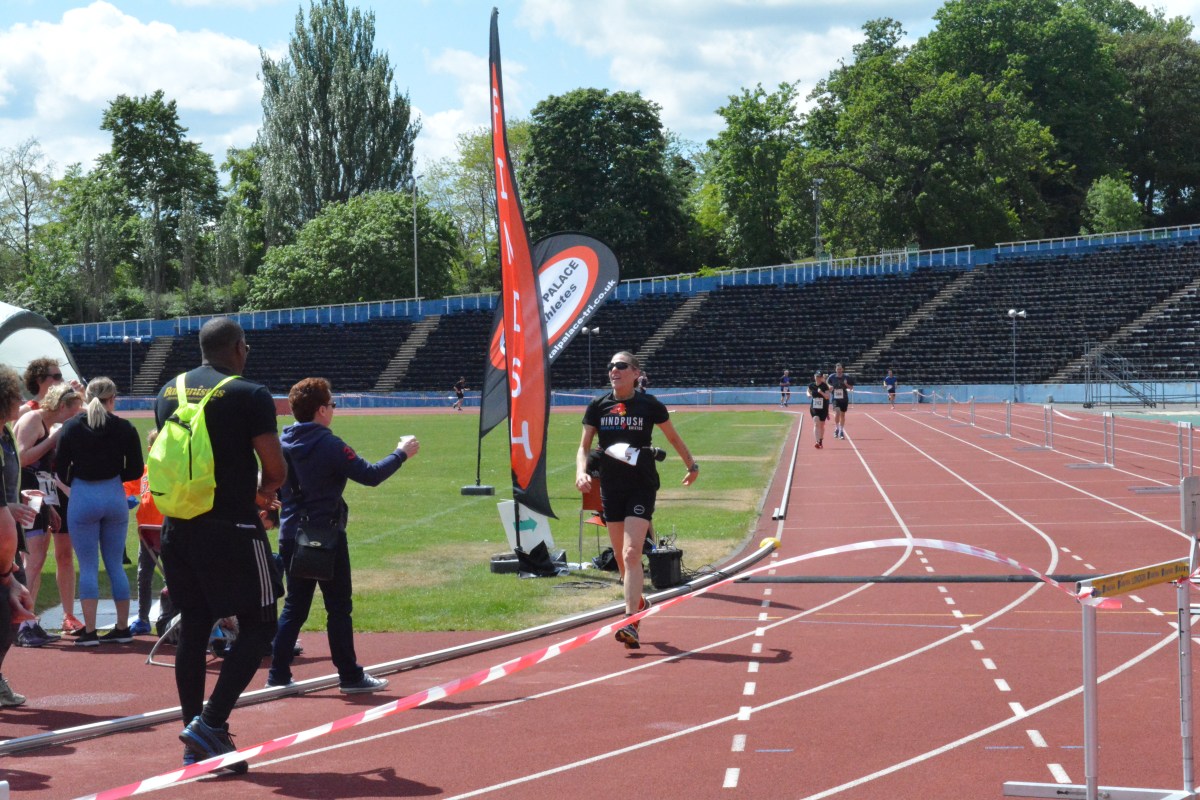
Having changed into running gear, we headed out into the brilliant afternoon sunshine to run part way of the route and see where it would take us. It was roughly the same as the bike route, except it wasn’t as long. We have to cycle nine times around the bike route and run twice (taking in a car park to make up the 5k), ending up in the track, THE TRACK, where we will be welcomed by a crowd of mostly strangers, and end our tri by running one and a half times around THE TRACK, before collapsing and saying never again.

Exhaustion set in. Fatigue arrived. This was only the novice training session.

I’m glad I signed up for this because really, I wouldn’t have had a clue on the day, I would have panicked and probably gone home. This gave me the chance to see who I was up against, that it really didn’t matter if I came last, because I am not an elite athlete or a pro, I am not training to break my own record because I don’t have a record to break. If I get through it before sunset I will be delighted. If I get through it without damaging myself I will be more delighted. If I get through it without damaging someone else, even better.

Of course this is the first of two sprint triathlons. The second is in July when I will do the same all over again, except in the middle of London and swim in a wetsuit in the Thames. I have a whole new set of hurdles to deal with but to conquer my fear of open water swimming, I have signed up for a session in a reservoir in Stoke Newington one Saturday morning in May at 7.30am.

Oh, and I have joined Windrush, the local triathletes, which means more new gear and apparently lots of cake and jelly beans. Now I can train with them whenever I like. So far I have been to the velodrome using my road bike, a very different experience to riding fixies (fixed gear no brakes) on the same track, which I do most Thursday mornings. And because I’ve been going to the velodrome since Oct, I was confident and for once knew what I was doing and that felt fantastic. Today I was up at six for an hour’s endurance swim session in a Clapham pool, a new venue for me. I lost £1 in a locker that had no key, and having no other change, a man came to my rescue and gave me his £1. Newbie nerves, we all have them, the first of anything is the worst. I become clumsy and say stupid things and act as if I don’t know anything. And for some reason I have to tell people my age as a pre-requisite to my impending leisurely stroke/run/cycle rate, as if that is a good enough excuse not to be as fast as the rest.

This morning’s session was in a 25m pool and I am used to a 50m pool, so why was it so hard? When the lovely coach said, right let’s do a warm up – 100 freestyle, breaststroke and backstroke, I assumed she meant 100 lengths of each and again, I went into a panic, until I realized that I would be there all day! Although I’ve never tried backstroke until today, I was helped by a young woman in my lane, another member of Windrush, who told me how to count to the end of the lane once I reach the second lot of flags. And suddenly it all felt okay.

Ageing does make us slow down and takes its toll on us in different ways. We’re not as fast, our joints ache, injuries take longer to heal, fatigue sets in sooner. It’s just the way it is. I’m not old, but I am older and slower than the younger triathletes. They have all been totally supportive and no one has looked at me as if I am some middle-aged loon, trying to recapture my youth and prove I am as good as them. I’m not. And that is okay. I am enjoying this journey because I know it won’t last. I want to experience it all and do it all, push myself and try to be the best I can. And if I fail, well, so what? I can always do it all over again next year…


Mum Care. Part 2

7.15 am. Sitting in my mum’s living room, while she sleeps upstairs. I’m staring out of the window at a thin cloud of mist hanging between the branches and loft conversion rooftops. It is exceptionally quiet, which is strange because it always seems to be noisy here at the rear of the house, from the many deliveries to the huge kosher supermarket that backs onto my mum’s garden. It is silent and warm, and I am comfortable in my mother’s house and in my father’s old, red velvet dressing gown.

Going to unlock the front door, I notice there is no Daily Telegraph shooting through the letterbox. This surprises me, although I am the one who stopped the subscription, because mum’s eyes have deteriorated so much she cannot read the small print and the headlines don’t give her enough information. She loves the news, likes to keep up with the daily chaos in the world, so I bought her a gigantic radio from the RNIB shop – the Royal National Institute for the Blind. The radio is very large and black with gigantic yellow dials that she can feel and work her way through. I have programmed LBC (she has taken to James O’Brien), Radio 4, Radio 5 because she likes sport and BBC London. She told me that she listened to a programme about Nina Simone on Radio 4, and how my father used to love her music. I am very proud of my 88 1/2-year-old mother, who has had to learn new technology when she really does not like it. My father was the one who used to do everything. He was a kind and generous control freak, his inability to let others have a go or do it their way, has left my mum struggling to make decisions and choices, and lacking the confidence to believe in herself. I believe in her. She has mastered the television and sky TV controls, with help from one of her grandsons, a new microwave – I had to cut little strips of plaster and stick them on to the flush controls, so she could feel them and memorise where everything was. She has also learned how to use two new radios, and now a loop system for her hearing aids, which the council fitted yesterday, allowing her better hearing for the TV. I never understood how a loop system worked, now I know and it’s bloody marvellous! She’s mastered it all. Not bad for a woman who still used an electric typewriter until she retired several years ago. Mum has had to adapt and learn very fast, because I am not here 24/7, because I cannot be here 24/7. She has learned to trust her skills, learned to trust that she can feel her way around the house, learned to hold a finger to the rim of a glass when she is pouring water so that it doesn’t overflow. She is completely blind in one eye, the other has partial sight. At 88 1/2 my brilliant mother has learned new skills.

The sun is shining and warm on my skin as I leave mum, still sleeping in the morning sun soaked room, and walk ten minutes up the road to our friend’s flat, where his new carer, MV, started work yesterday. Our friend’s wife died a month ago, he requires a lot more help than mum but they and we have come to an agreement. MV will stay with him overnight and come to mum several mornings a week. Mum’s not ready for a full-time carer, it’s hard enough getting used to having a stranger in the house for a few hours a week let alone someone new moving in. It’s a massive adjustment for all sorts of reasons. But a gradual adjustment is the way to go.

Our friend’s son and I grew up together in North London, then went our separate ways. Now our parents, two very old friends, have found themselves sharing a carer, something none of us imagined or prepared for. Today is MV’s first morning with mum. I met her yesterday afternoon to ensure I liked her, mum liked her and that she liked us! She is delightful, has a delicious smile, is quiet, very caring and kind, and worked for our friend’s cousin for over a year until he recently died. She is everything we could want in a carer. I find it hard to hold in my emotions, and my responsibility towards my mother grows each day. I often think this is how it must be for parents handing over a small child to a complete stranger.

As I leave the house, smells of fresh bread and cakes from an abundance of bakeries, arouse my senses, and I am tempted to go and buy bags of just baked carbohydrates, sweet and sticky. I have walked up this road many times, because this is where I grew up. I have walked to and from the stations, to the ABC cinema now a care home, across the road to the Sobell Centre, once a Convent. I remember the nuns in the late 60s and 70s rushing up and down in their habits. And I walked to the library with my mum and dad and sister, and spent many happy hours choosing books. I walked to my grandparents, and up to the shops in Golders Green as a teenager, have seen so much change take place; the rent rises, shops opening and closing.  Now I am walking up the road to collect my mum’s carer.

I arrive much sooner than I anticipated, my memory has not served me well in terms of time travel. It’s geographically so close, that the cup of tea I have left in the living room is still warm when I return.

MV and I walk down to mum’s, chatting as if we have known each other for years. I take to her immediately, and suddenly feel a lot easier than I did 15 minutes earlier. She knows the area, is familiar with this way of life. I have given MV a set of keys, walked her around the house, told her how mum likes a cup of tea in the morning with two saccharine, and then I walk her upstairs to mum and leave them alone to get to know each other. This is the moment we have been pondering since my dad died. And now it is here, it feels okay and right. I feel okay and right and calm.

The journey to this point has been hard, with mum’s friends pestering her to get help and my wanting to do what’s right for mum, what mum wants. It is, after all, her life, her home, and mentally she is sharp as anything. She remembers phone numbers like an eager new actor memorising lines. She repeats them to me with a smile on her face and I say, see mum, you definitely do not have dementia. Interviewing other carers, my main concern was around trust, about mum liking the carer and the carer liking mum. I constantly worried about all the what ifs. But MV came into our lives quickly and it feels as if she has always been here, and that, I suppose, is how it’s meant to be. There are no bells ringing out, it just feels right.

MV is shocked that mum goes all the way upstairs to bed. And I tell her, it’s very important to let the older people do as much as they can, to feel a sense of pride, of physical and mental achievement. It is vital we support them but do not take over, until the point where we have no choice. Personally I hope mum always has a choice. Yesterday she whispered to me, I hope I slip away quietly and don’t give you any trouble.

Sitting in the living room, drinking my warm tea, after the pump of the shower has stopped, I hear them chatting and laughing upstairs, and my heart sings. There is no hesitancy, no fear that I have done the wrong thing. An enormous sense of relief overwhelms me. I hope mum is happy with this new routine. I know I am.  She already seems lighter, happier, perhaps she too is relieved? I turn to the window to the familiar chirping of magpies, and see two of them sitting on the fence looking at me. And I look back and smile.

Day 5. Fixation

Ned Flanders: “You were bicycling two abreast?”
Homer Simpson: “I wish. We were bicycling to a lake.”
The Simpsons, ‘Dangerous Curves’ (Episode 2005), first broadcast, November 10th 2008

Velodrome – from French vélodrome, from vélo ‘bicycle’ + -drome

Noun
1.   An arena or structure for equestrian and other spectacles.
2.  In ancient Greece and Rome an oval track for horse races and chariot races.


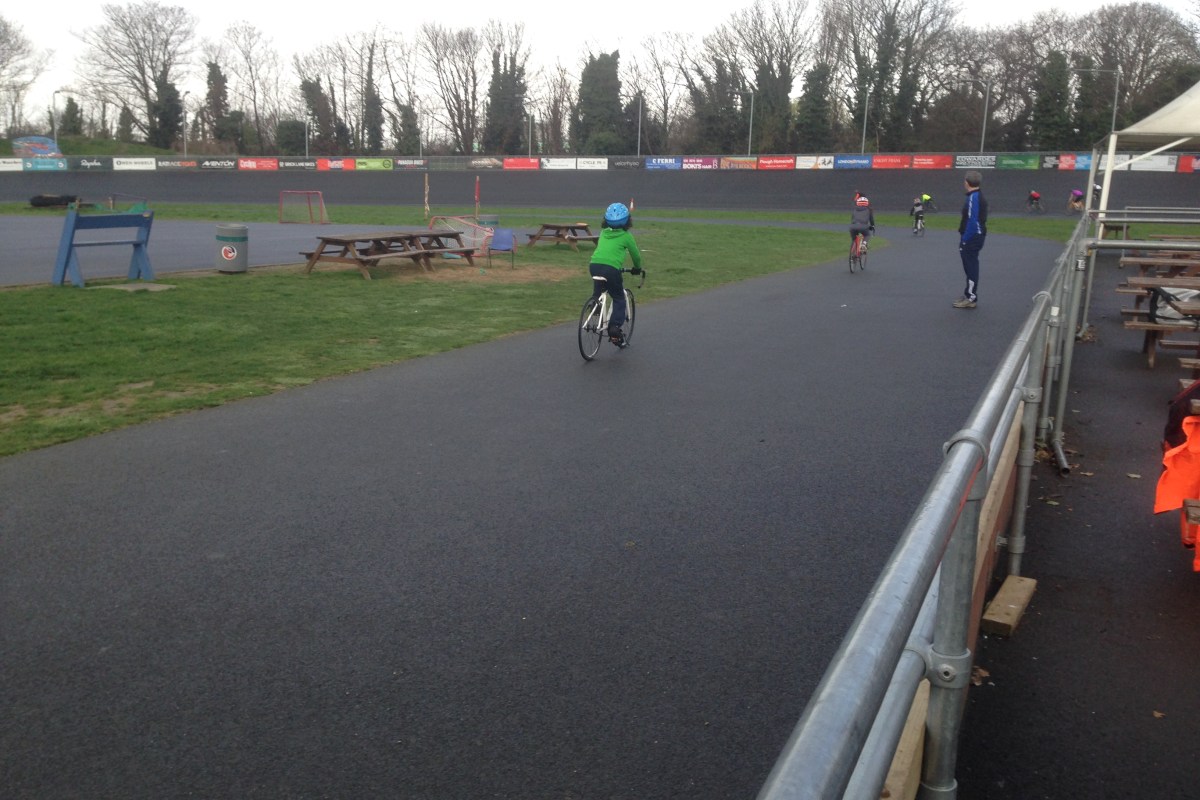
Ok, so it’s time to tell you about my velodrome experience. I’ve lived in SE London for 19 years and I love it. I love the proximity to the centre of town (3 miles from Waterloo, it takes me an hour to walk to the Southbank from my house), the green spaces within walking distance (Ruskin, Brockwell and Dulwich parks) and many other goodies on offer, Brockwell Park Lido (of course), and Herne Hill Velodrome, where the 1948 Olympics took place. I’m not one for cycling in traffic, commuting on two wheels is definitely not my thing. But how was I to get used to a bike without braving London traffic. The velodrome in Herne Hill, that’s how. In late autumn 2016 I realised that this could be the solution to all my cycling woes. The gym bikes are not the same as cycling on the road or a track. Herne Hill Velodrome is close to the house, I already had the helmet and gloves, bikes were on loan as part of the £5 charge. After extensive research, Thursday mornings or Sunday evenings were the only slots for my level. Thursday from 9-10am is for the over 40s and women’s easy riding session. Sunday from 5-7pm is women only. So far I haven’t made it to the Sunday session, Thursdays are easier and a great way to start the day and only one hour long.

Before my first session began I had to find a bike that fitted me. I’m a 49 frame. I wheeled the bike over to the track and watched as other riders kitted up, pumped up tyres, changed pedals so they could clip in and then I watched them cycle past and I was very nervous.   It was a beautiful sunny day, not too cold, I was prepared with layers of clothes.  There are two tracks at the velodrome, the main track, which has a 30- degree gradient, I’m not sure what the technical term is for that, perhaps someone can tell me, and an inner, flat track, used for inductions and other sessions. The first thing they teach you is how to push off and stop. No gears and no breaks. Fixie bikes. Called Fixies because they have a fixed gear. Some people find this daunting and wouldn’t go near a fixie, but I love them. Less to worry about and if everyone was braking there would be loads of accidents and pile-ups. Makes sense. But it is bloody hard, relentless work, because you physically cannot stop pedalling.

Once my toes were in the clips, hard to adjust when you’re sitting on a bike without falling off, I had to steady myself and then push off from the barrier. When you want to stop, you cycle against the pedals, which eventually slows you down and you edge towards the barrier and as you come to stillness you hold on. I found this quite easy, once you’ve got it it’s not hard to do and came quite naturally. Cycling on a small, flat track is one thing, progressing to the main track was a very different experience. I was terrified. What if I fell off the gradient? What if I crashed into someone else? What if I couldn’t do it? I cycled around the main track for about fifteen minutes, just to get the hang of it, but also to work my way up the gradient along the different colours that differentiate the next level of slope. Cycling at the very top of the gradient is hard, but shooting down to the flattest level is a feeling of utter joy and exhilaration and 10-year-old Shelley loved it.   Fifty seven year old Shelley loved it too. Time to go home, with my legs a little wobbly, I would return the following week to join the regular track riders. I thought of the Brownlee brothers, running that distance after cycling so long after swimming so far. I shook all the way to the car…how would I hold up after swimming 750m, cycling 12 miles and running 5k with wobbly legs?

The Thursday morning riders at the velodrome are a mix of super speedy men and women who are all younger than me, and they are super speedy too. I am not. They are all lovely, friendly, encouraging people who give advice like YOUR SEAT IS TOO LOW. I have made a bike buddy with a 71-year-old, who had never ridden a bike before setting foot on the velodrome several months ago. He is slower than me.  Every week is different, but usually starts with a warm up of several laps and then you all ride round together in a peloton – French, literally ‘small ball’ because of the concentrated grouping of the pack – except for me and my 71-year-old bike buddy. It’s hard to cycle twice as fast as everyone else to ensure your front wheel is practically but never touching the back wheel of the rider in front of you and keep doing it for 25 laps. I tried, I couldn’t keep up and yes men are generally stronger than women, but those women, wow. And I thought I was fit. Week 2 proved more difficult than I imagined and I was beginning to have doubts about track racing and sprint triathlons, what on earth was I doing and why was I doing it? I went home deflated. I hate not being brilliant at anything immediately, this was proving no different to any other challenge I set myself. The great thing is, at the velodrome, no one minds what anyone else does as long as you STAY DOWN and let others pass. That’s what the speedy cyclists call out, if you’re down on the lowest level and they are approaching they shout, STAY DOWN, in case you decide to shoot up the slope and cause chaos. You learn the rules fast, you have to.  You have to stay focussed. The last thing I would want to do would be to hurt anyone. I also discovered that it was actually okay for me not to keep up, to take things at my own pace, to gradually improve. All the other riders were cycling enthusiasts, they cycled everywhere. They’d had practice. I was doing it for pleasure, for exercise and as a means to an end. It is the hardest exercise I have ever taken. The good thing is that my bottom doesn’t hurt at all, probably because my glutes are so tight, I have no pain during or after a session. My legs have become used to the pressure and each week I have improved. I even took part in a race before Christmas. Split into two groups, the slower one starts up at the top of one side of the track, the faster riders at the other end at the top. The person at the front of each group does a lap and pulls off, which means whoever is at the back has to do the most laps…and then we see who has won. I went third in the slower group and apparently I stormed it. Perhaps sprinting is my thing?

A few days before Christmas, it was a beautiful freezing cold, sunny day. Thick socks, cycling shoes, which I invested in, because the trainers I’ve tried are either freezing cold or too bulky. Sale cycling shoes, they didn’t cost a fortune and I intend to try clipping in at some point. What was that I said about not clipping in? Glove liners and gloves, a thin beanie to keep my head and ears warm under my helmet. I bought a pair of cycling glasses that have chromatic lenses on the outside and prescription lenses clipped inside. I am short sighted and need to see! I tried wearing my regular glasses, but the ones with the magnetic sunglass clips fell off and if I wear regular glasses, sudden glare or sunshine is too much for my delicate, green eyes. Changing glasses mid ride is impossible. These are probably the best accoutrement I have bought. I use them for running too. They stay on, they are brilliant, I don’t even feel as if I am wearing glasses. Thanks to the Bike Rooms for patience and assistance.

So, 3 days before Christmas and we’re about to end the session when it is decided that we will turn our bikes around and cycle around the track in the opposite direction which most people didn’t warm to. We were to do as much or as little as we could, making waves, so up and down the gradient, staying safe all the time. At the end, all of us holding on to the barrier, the instructor asked if anyone enjoyed it. Guess who put up her hand? It felt more natural to me, sorry, but it did.

After a few weeks break due to holidays, icy conditions or rain, I returned today. I managed 40 laps – 5 warm up laps, then 25 then 10. I couldn’t stay in a peloton with the others, they are all too fast for me, but it was the first time I did 25 laps non-stop. My bike buddy was with me. Cycling behind, he kept calling to see if I was okay. I’M FINE ARE YOU OKAY? A voice called back, ‘I’m not sure I can do much more.’ YES YOU CAN. After two more laps, we checked on each other, all the time STAYING DOWN while the speedy riders whizzed past. ‘I think I have to stop.’ DON’T STOP, YOU CAN DO IT, KEEP GOING. And then the bell and I smiled to myself, because I had done it, but so had the 71-year-old. He patted me on the shoulder. ‘You did that, you made that happen, you kept me going, thank you, thank you so much, I’ve never done that before.’

Others congratulated me on keeping going, on doing better, on not stopping. I was jubilant, my legs were jubilant. I am fixated on fixies. They are trendy but not new inventions and some now have brakes. I wouldn’t want to ride one in real life, all those hills and no brakes and traffic, but riding around a track on a fixie is pure joy.   Fact – in 1876 Madison square garden was originally built in order to accommodate fixed gear bike racing track.

***

I bumped into the 71 year old (I must ask his name) when I went to the bank straight after the session. He shook my hand. ‘Thank you, thank you, I wouldn’t have done it, if it wasn’t for you, you kept me going.’

Yes, I said, but you kept me going too. I was learning to ride in a team. As someone pointed out to me, be ready to run, swim, bike with others around you. I was learning and learning fast, now all I need to do is cycle fast…

Next time…day 6. My first back to back.


Day 4. “When my legs hurt, I say: ‘Shut up legs! Do what I tell you to do!’” Jens Voigt, German cyclist

It’s 2017, which means my triathlon training has begun. Properly begun, not just in my head begun, with me telling myself I will start training, with my imagining the day and how it will be, with crowds applauding me as I run energetically to the finish line, tanned, lean and fast. And most probably last. I’m not competitive. Yes, I’m actually doing it, training for real, doing some form of exercise every day and I love it. Many of you will squirm at the words exercise and love joined up in a frenzy of adoration. But I do love exercise. I love having exercised even more, especially as I reward myself with nutritious treats. With swimming and running coming along well, with 5k nailed and a freezing cold pool I haven’t actually jumped in since a charity swim in November – Crystal Palace pool, make your waters warm for me – cycling was the next thing to tackle.

With all that talk of a lovely friend lending me a MTB (remember what that stands for?), I decided that having my own bike would be best. Of course I have a wonderful wife who supports my every sporting need. She bought me a bike; she even cleared out the shed so I could store my bike (the bike shed was too far away, I’d need to drive there to get my bike). I went to the local bike shop, was measured for the right size frame, of course me being me, I’d done heaps of research into which bike I might like as an entry-level bike. I was shocked at how expensive some of them are, shiny and many geared, with all sorts of accessories available. And cycling clothes ARE SO EXPENSIVE. Anyone want to sponsor me? I’ll happily have your name embroidered on my lapel. The lovely men in the bike shop helped me and answered my many questions. I even signed up for a maintenance course, which saw me and three men try and imagine changing a burst inner tube. Isn’t there a cycling version of the AA to do that? When I went to collect my bike, I realised I had to cycle home, up a steep hill and in traffic. Terror struck. I was used to driving those roads in a car, not on two wheels with a bus chugging out fumes in my face and a racer boy desperate to overtake me without forcing me into a ditch. Four wheels have been my friends since I was seventeen. I’m usually the one who carefully overtakes cyclists, who raises my fists at those on two wheels going through red lights or down one-way streets the wrong way. It’s bad enough when swimmers overtake you in the slow lane, but now I had to get used to other cyclists overtaking me. I’m not competitive. Really, I’m not.

Before I walked my bike to the road, the nice men in the bike shop showed me everything, where the gears were, how to use them, they ensured my seat was the right height, we changed the pedals to ones without toe clips, mostly because the pedals that came with the bike were not very good. The man in the bike shop asked if I intended to get clipped-in pedals? No, I said, of course not, I’m happy with my trainers and regular pedals. What kind of a cyclist do you think I am? Ok, he said, and fitted my new pedals. While he did this, and attached my pump and lock, I looked around at the people in the bike shop, mostly men with big bellies and cling film Lycra and road shoes that tapped along the wooden shop floor. And one other middle-aged woman, who, like me, was nervous about having a first bike for many, MANY years. A kindred sprit, I suddenly felt I was not alone anymore in my cycling world.

The nice man in the bike shop gave me my bike and off I went, taking my time, aware that no one but me knew I was terrified. I don’t remember much about that short journey home, other than a roundabout, my arms trying to indicate (it’s so easy in a car) that I was about to veer around it, my brakes giving me the shock of my life and almost catapulting me over the handlebars (I wonder if anyone heard me scream), and the steep hill, which I bravely took like a pro (it’s so easy in a car), sweat dripping down my face, face red with blood pumping through my body, my heart ranging away. What was that I said about tanned, lean and fast?

I am now in love with my bike. My friend Lizzie thinks it needs a name. Her bike is called Robert. Any suggestions? I never thought any other bike could surpass the love I felt for my orange Chopper, when I was age 13, but this one is special. It has been in the shed for a few weeks because I won’t ride in the rain, I won’t ride in traffic and quite frankly, finding the time to fit in swimming, running, cycling, the gym, Pilates AND yoga AND work AND my mum AND my life, requires a PA to create a spreadsheet for me. But don’t worry, my wife has found me a lovely local route that will take me away from traffic, and last week we cycled from our beach hut to Reculver and back…on a fold up bike (NOT A BROMPTON) which is much harder because its wheels are smaller! It was hard but we did it. A little windburn is good for the soul. Those of you who think cycling shorts are stupid are SO WRONG. I love my padded pants.

I’d hate you to think I’m not cycling. I am. Several weeks ago I had a great idea. To get fit on a circuit I knew I could make every week, that would be open unless it was raining heavily or was too icy. Herne Hill velodrome, close to home, on a track, no traffic and lovely people and cost £5. It is the home of the 1948 Olympics. Thursday mornings are for the over-40s, and women’s easy riding. I did my induction course and off I went. Let’s just say that it’s not that easy, and there’s a big difference in energy levels between those who are just over 40 and those of us who are 57 and not regular cyclists…I had no idea track bikes have no gears and no brakes…Olympians, watch out.


Up next…Riding a fixie.